
Collection of saved resources
Bookmarks
the void
Who is this? This is me. Who am I? What am I? What am I? What am I? What am I? I am myself. This object is myself. The shape that forms myself. But I sense that I am not me. It's very strange. - Rei...
In Depth: How Labubu Became a Monster of a Business
Chinese retailer Pop Mart’s success with the creepy-cute elves offers a case study in how to turn a little-known character into the must-have toy of the year
The C4ISR Architecture Behind China's Autonomous Airpower
The Datalinks, Hardware, and Algorithms Enabling the PLA's Autonomous Kill Web and How They Compare to U.S. Efforts.
Is RL + LLMs enough for AGI? — Sholto Douglas & Trenton Bricken
New episode with my good friends Sholto Douglas & Trenton Bricken. Sholto focuses on scaling RL and Trenton researches mechanistic interpretability, both at Anthropic. We talk through what’s changed in the last year of AI research; the new RL regime and how far it can scale; how to trace a model’s thoughts; and how countries, workers, and students should prepare for AGI. See you next year for v3. Enjoy! 𝐄𝐏𝐈𝐒𝐎𝐃𝐄 𝐋𝐈𝐍𝐊𝐒 * Transcript: https://www.dwarkesh.com/p/sholto-trenton-2 * Apple Podcasts: https://podcasts.apple.com/us/podcast/dwarkesh-podcast/id1516093381 * Spotify: https://open.spotify.com/episode/3H46XEWBlUeTY1c1mHolqh?si=b645971b1af546fa * Last year's episode: https://www.youtube.com/watch?v=UTuuTTnjxMQ 𝐒𝐏𝐎𝐍𝐒𝐎𝐑𝐒 * WorkOS ensures that AI companies like OpenAI and Anthropic don't have to spend engineering time building enterprise features like access controls or SSO. It’s not that they don't need these features; it's just that WorkOS gives them battle-tested APIs that they can use for auth, provisioning, and more. Start building today at https://workos.com. * Scale is building the infrastructure for safer, smarter AI. Scale’s Data Foundry gives major AI labs access to high-quality data to fuel post-training, while their public leaderboards help assess model capabilities. They also just released Scale Evaluation, a new tool that diagnoses model limitations. If you’re an AI researcher or engineer, learn how Scale can help you push the frontier at https://scale.com/dwarkesh. * Lighthouse is THE fastest immigration solution for the technology industry. They specialize in expert visas like the O-1A and EB-1A, and they’ve already helped companies like Cursor, Notion, and Replit navigate U.S. immigration. Explore which visa is right for you at https://lighthousehq.com/ref/Dwarkesh. To sponsor a future episode, visit https://dwarkesh.com/advertise. 𝐓𝐈𝐌𝐄𝐒𝐓𝐀𝐌𝐏𝐒 00:00:00 – How far can RL scale? 00:16:27 – Is continual learning a key bottleneck? 00:31:59 – Model self-awareness 00:50:32 – Taste and slop 01:00:51 – How soon to fully autonomous agents? 01:15:17 – Neuralese 01:18:55 – Inference compute will bottleneck AGI 01:23:01 – DeepSeek algorithmic improvements 01:37:42 – Why are LLMs ‘baby AGI’ but not AlphaZero? 01:45:38 – Mech interp 01:56:15 – How countries should prepare for AGI 02:10:26 – Automating white collar work 02:15:35 – Advice for students
Continuous Thought Machines
Introducing Continuous Thought Machines: a new kind of neural network model that unfolds and uses neural dynamics as a powerful representation for thought.
A Survey of AI Agent Protocols
The rapid development of large language models (LLMs) has led to the widespread deployment of LLM agents across diverse industries, including customer service, content generation, data analysis, and even healthcare. However, as more LLM agents are deployed, a major issue has emerged: there is no standard way for these agents to communicate with external tools or data sources. This lack of standardized protocols makes it difficult for agents to work together or scale effectively, and it limits their ability to tackle complex, real-world tasks. A unified communication protocol for LLM agents could change this. It would allow agents and tools to interact more smoothly, encourage collaboration, and triggering the formation of collective intelligence. In this paper, we provide the first comprehensive analysis of existing agent protocols, proposing a systematic two-dimensional classification that differentiates context-oriented versus inter-agent protocols and general-purpose versus domain-specific protocols. Additionally, we conduct a comparative performance analysis of these protocols across key dimensions such as security, scalability, and latency. Finally, we explore the future landscape of agent protocols by identifying critical research directions and characteristics necessary for next-generation protocols. These characteristics include adaptability, privacy preservation, and group-based interaction, as well as trends toward layered architectures and collective intelligence infrastructures. We expect this work to serve as a practical reference for both researchers and engineers seeking to design, evaluate, or integrate robust communication infrastructures for intelligent agents.
Generalization through variance: how noise shapes inductive biases in diffusion models | OpenReview
How diffusion models generalize beyond their training set is not known, and is somewhat mysterious given two facts: the optimum of the denoising score matching (DSM) objective usually used to train...
Sun Yuan and Peng Yu: Can’t Help Myself
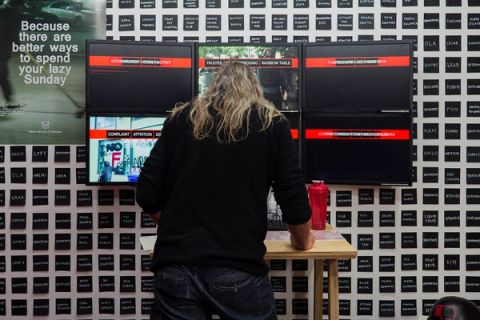
The Chinese artists Sun Yuan and Peng Yu participate in the 58th International Art Exhibition in Venice with their work “Can’t Help Myself” (2016). For this piece, Sun Yuan and Peng Yu use a Kuka industrial robot, stainless steel and rubber, cellulose ether in colored water, lighting grid with Cognex visual-recognition sensors, and polycarbonate wall with aluminum frame. Info text (Guggenheim): In this work commissioned for the Guggenheim Museum, Sun Yuan & Peng Yu employ an industrial robot, visual-recognition sensors, and software systems to examine our increasingly automated global reality, one in which territories are controlled mechanically and the relationship between people and machines is rapidly changing. Placed behind clear acrylic walls, their robot has one specific duty, to contain a viscous, deep-red liquid within a predetermined area. When the sensors detect that the fluid has strayed too far, the arm frenetically shovels it back into place, leaving smudges on the ground and splashes on the surrounding walls. The idea to use a robot came from the artists’ initial wish to test what could possibly replace an artist’s will in making a work and how could they do so with a machine. They modified a robotic arm, one often seen on production lines such as those in car manufacturing, by installing a custom-designed shovel to its front. Collaborating with two robotics engineers, Sun Yuan & Peng Yu designed a series of thirty-two movements for machine to perform. Their names for these movements, such as “scratch an itch,” “bow and shake,” and “ass shake,” reflect the artists’ intention to animate a machine. Observed from the cage-like acrylic partitions that isolate it in the gallery space, the machine seems to acquire consciousness and metamorphose into a life-form that has been captured and confined in the space. At the same time, for viewers the potentially eerie satisfaction of watching the robot’s continuous action elicits a sense of voyeurism and excitement, as opposed to thrills or suspense. In this case, who is more vulnerable: the human who built the machine or the machine who is controlled by a human? Sun Yuan & Peng Yu are known for using dark humor to address contentious topics, and the robot’s endless, repetitive dance presents an absurd, Sisyphean view of contemporary issues surrounding migration and sovereignty. However, the bloodstain-like marks that accumulate around it evoke the violence that results from surveilling and guarding border zones. Such visceral associations call attention to the consequences of authoritarianism guided by certain political agendas that seek to draw more borders between places and cultures and to the increasing use of technology to monitor our environment. (Xiaoyu Weng) Sun Yuan and Peng Yu: Can’t Help Myself. 58th International Art Exhibition, “May You Live In Interesting Times”, La Biennale di Venezia, Central Pavilion, Giardini. May 8, 2019. #venicebiennale #biennalearte2019 #sunyuanpengyu More videos on contemporary art, design, architecture: http://vernissage.tv Connect: http://www.facebook.com/vernissagetv http://twitter.com/vernissagetv Browse our Archive: http://vernissage.tv/archive/posts/ Find Artists, Designers, Architects: http://vernissage.tv/archive/artists/ Art TV pioneer Vernissage TV provides you with an authentic insight into the world of contemporary fine arts, design and architecture. With its two main series "No Comment" and "Interviews", art tv channel VernissageTV attends opening receptions of exhibitions worldwide, interviews artists, designers, architects. VTV provides art lovers with news, reports and features from the international art scene. VernissageTV: the window to the art world. Das Fenster zur Kunstwelt. La fenêtre sur le monde de l'art. A janela para o mundo da arte. La ventana al mundo del arte. نافذة على عالم الفن. 到艺术世界的窗口。Окно в мир искусства. Since 2005.
Three Tomorrows PNT SARDAR SWEENEY Futures 2016.pdf
PDF Document
Tweet by Alex Volkov (Thursd/AI)
HOLY CRAP, a new super tiny 1.6B param voice model just dropped that seems to.. outperform 11labs!? 😵💫 From Nari-labs, Dia is an Apache 2.0 voice model, that can generate laughs, sniffs and emotions, copy an existing voice and is effectively real time on larger GPUs:
On the Biology of a Large Language Model
We investigate the internal mechanisms used by Claude 3.5 Haiku — Anthropic's lightweight production model — in a variety of contexts, using our circuit tracing methodology.
Animation Obsessive Staff on Substack
A few proof-of-concept cels created for Hayao Miyazaki and Isao Takahata's unmade Pippi Longstocking series in the early '70s.
Watch incredible moon landing of spacecraft Blue Ghost captured in stunning video
Texas startup Firefly Aerospace made history Sunday when it landed its spacecraft, Blue Ghost, on the lunar surface with a flawless touchdown. —–– Subscribe to ABC News on YouTube: https://abcnews.visitlink.me/59aJ1G Watch 24/7 coverage of breaking news and live events on ABC News Live: https://www.youtube.com/watch?v=gN0PZCe-kwQ&ab_channel=ABCNews Watch full episodes of World News Tonight with David Muir here: https://youtube.com/playlist?list=PLQOa26lW-uI8ixlVw1NWu_l4Eh8iZW_qN&feature=shared Read ABC News reports online: http://abcnews.go.com ABC News Digital is your daily source of breaking national and world news, exclusive interviews and 24/7 live streaming coverage. ABC News is the home to the #1 evening newscast “World News Tonight” with David Muir, “Good Morning America,” “20/20,” “Nightline,” “This Week” with George Stephanopoulos, “ABC News Live Prime” with Linsey Davis, plus the daily news podcast “Start Here.” —–– Connect with ABC News on social media: Facebook: https://www.facebook.com/ABCNews Instagram: https://www.instagram.com/abcnews TikTok: https://www.tiktok.com/@abcnews X: https://twitter.com/ABC Threads: https://www.threads.net/@abcnews LinkedIn: https://www.linkedin.com/company/abcnews
Original 71a9c8c752ee1ad61a47b4f0bf8c9e7d
npm create mastra https://t.co/qnKr84XBOe— Mastra (@mastra_ai) February 28, 2025
Building Agents with Model Context Protocol - Full Workshop with Mahesh Murag of Anthropic
The Model Context Protocol is a universal, open standard for connecting AI systems with data sources, replacing fragmented integrations with a single protocol. This workshop from Anthropic -- the creators of MCP -- talks about the philosophy behind MCP, its impact on the broader ecosystem since launch, and how developers can use it to build context-rich AI apps and agentic experiences. 00:00 What is MCP? 9:39 Building with MCP 26:25 MCP & Agents 1:13:15 What's next for MCP? Recorded live at workshop day from the AI Engineer Summit 2025 in NY. Learn more at https://ai.engineer and purchase tickets to our next event, the AI Engineer World's Fair, in SF June 3 - 5 here: https://ti.to/software-3/ai-engineer-worlds-fair-2025 About the instructor Mahesh is a Member of Technical Staff on Anthropic's Applied AI team, focused on Model Context Protocol, agents, and helping make Claude more useful to enterprises. He was previously a Product Manager at Scale AI & Tecton and did research at UC Berkeley on how self-driving cars impact traffic systems.
China’s Trump Strategy | Foreign Affairs
Beijing is preparing to take advantage of disruption.